


US to Cut Health Funding to Kenya Gradually Under New Ksh325 Billion Deal

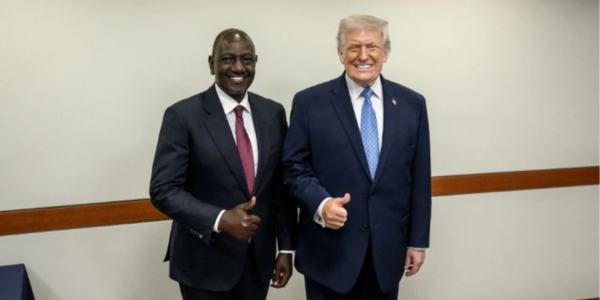
The United States plans to gradually reduce its health funding to Kenya over the next five years under a new $2.5 billion (about Ksh325 billion) agreement designed to push the country toward financing its own medical system.
Speaking on NTV on Wednesday, November 25, US Embassy Acting Chargé d'Affaires Carla Benini said Washington is moving away from traditional donor support in favor of a self-sustaining model.
"Our current administration is looking to emphasise a trade-not-aid model, and the idea is that after the end of those five years, Kenya will be able to stand on its own," Benini said.
Under the Kenya-US Health Cooperation Framework, signed on December 4, 2025, by President William Ruto, Prime Cabinet Secretary Musalia Mudavadi, and US Secretary of State Marco Rubio, American financial contributions will be front-loaded.
Benini noted that the US is investing $1.6 billion in the initial years to build essential health infrastructure before Kenya gradually takes on greater financial and management responsibility.
"The investment from the U.S. government is high in the early years at 1.6 billion, and that is just to ensure Kenya has the health system structures in place," she explained.
The five-year pact, reported in some official figures at Ksh323 billion, targets HIV, tuberculosis, and malaria programs, disease surveillance, laboratory services, medical supplies, healthcare workers, and digital health systems.
A portion of the funds will go toward reforming the Kenya Medical Supplies Authority (KEMSA), improving access to essential medicines, and expanding the government's Digital Health Superhighway.
Despite the push for self-reliance, the deal faces a High Court challenge over patient data privacy and the level of public participation held during negotiations. Petitioners argue that sharing medical records under the agreement could violate Kenya's Constitution and the Data Protection Act.
Benini rejected claims that the pact compromises patient confidentiality, insisting that all shared medical records are stripped of personal identifiers.
"There is data that is collected that is completely removed from an individual. It has literally nothing to do with an individual. In simple terms, it is anonymised. There should not be any data privacy concerns among the Kenyan people," she said.
According to the envoy, tracking anonymized health data allows both governments to monitor disease patterns across populations and design better public health interventions.
She also dismissed suggestions that Kenya was given unfavorable terms compared to other nations partnering with Washington.
"I think it is important to note that there is nothing that is being done differently from other frameworks. I think Kenya is one of our strongest partners in the Sub-Saharan region," Benini said.


Comments
No comments yet — be the first.